
In memoriam
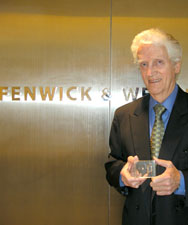
Bill Fenwick, 1938–2021
Bill was a close friend, mentor and inspiration, and half of the creative force behind ValleyZen. A truly remarkable human, he rose from extreme poverty growing up in western Kentucky, the son of a sharecropper and the first in his family to go to college, to co-found Fenwick & West and lead it into one of Silicon Valley's premier law firms. Along the way he incorporated Apple for Steve Jobs and Steve Wozniak and remained a close professional and personal advisor to Jobs. He did all of this with a relentless conviction in the power of technology to make the world a better place.
I know for certain that had he lived to see the current AI revolution, he would have been its greatest cheerleader and power user, stretching these new technologies daily to their limits. He died in Palo Alto on October 4, 2021. His posts here remain as he wrote them. May he rest in peace.
Drue Kataoka
The Epiphany
1964 was the year I had "My Epiphany" about information technology. Prior to 1964 I had no comprehension of what information technology was beyond the 15+ year old Royal portable typewriter I used for preparing term papers. I thought that computer were the two devices used by the media when discussing computers. One device had two whirling objects at the top of a cabinet. The other was a machine that ran what appeared to be paper cards through a conveyor and dropped them in various slots at a blinding pace. 1964 was also my first-year in law school. As a first-year law student I quickly gained an appreciation of how essential easy access to accurate, stored, voluminous information is to a society governed by law.
That same year I had begun work at Genesco's national computer operations center that operated 24 hours a day processing data for its large vertical conglomerate empire. After recognizing that tape drives and card sorter were peripherals not computers, I began to grasp that gathering; transporting and processing economic data was going to dramatically change the world.
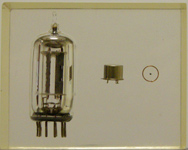
In 1964, Genesco Computer Center had three different generations of computers performing data processing and IBM had a virtual monopoly on all of them. Using three generations of computers in the same computer center posed a great challenge for system designers and programmers to transition the very expensively developed software from a computer generation make up of vacuum tubes to a generation built using solid state transistor and IC devises. Progress from one generation to the next is illustrated by the acrylic block above. The "core" or "brains" of the computer was made up of transistors. The miniature tube was the equivalent of a transistor or one byte in the 1st generation. A discrete transistor, with it's greatly reduce foot print and power consumption was one byte in the 2nd generation and the tiny dot was a byte in the 3rd generation solid state central processor. These breakthroughs in software and hardware resolved the generation transition challenge of data processing and enabled the "information revolution." System programmers were made the "High Priest" of all computer use.
My Epiphany in 1964 was the realization of the enormous disruption information technology would have on the economic, social and political policies and structures of our society. In future posts I will explore those issues as perceived by an unbelievably naïve young law student searching for the Zen principle of simplicity.